If you’ve ever stood at Hawks Nest and looked out across the New River, you might think you’re simply looking at one of West Virginia’s beautiful mountain views. But Hawks Nest is more than a place on the map. It is a place where the landscape, the river, the railroad, the mines, and the people who lived here all became part of a much bigger story.
For me, that story is personal. I’ve known Hawks Nest for much of my life. I’ve watched trains pass through, worked in the area for 23 years, and have family connections reaching back to the community. But the older I get, the more questions I find myself asking. What was Hawks Nest like before the railroad? Who was here? How did people get here? And when did this beautiful stretch of the New River become the Hawks Nest, we know today?
Where Hawks Nest Begins
Long before the railroad came through this part of the New River Gorge, Hawks Nest was already known as a remarkable landmark. In earlier accounts, the cliffs were also called Marshall’s Pillar. Travelers came through this region by river and along the old James River and Kanawha Turnpike, taking in the dramatic scenery that made Hawks Nest a place worth remembering
By 1843, Hawks Nest was already familiar to travelers passing through the region. A letter written that year by James Everhart, now preserved by the West Virginia & Regional History Center at West Virginia University, mentions “The Hawk’s Nest” while describing his travels through the area. We haven’t yet been able to examine the original letter ourselves, but the archive confirms that Hawks Nest was part of his travel account.
By 1851, a guidebook for travelers to the Virginia springs described the landmark as “Marshall’s Piller, or the Hawk’s Nest, as it is more generally called. “The guide placed it along the New River, close to the Kanawha Turnpike. So, before the railroad arrived people were already traveling through this region by road and river and knew Hawk’s Nest as a place worth seeing.
We also found an intriguing image from around 1840 showing Hawks Nest, also identified as Marshall’s Pillar. The image is preserved by the Library Company of Philadelphia and gives us a glimpse of how the landmark was being presented to the public before the railroad arrived.
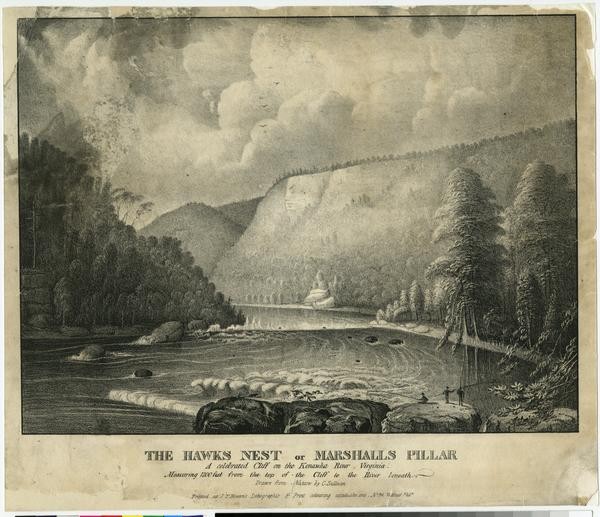
Just two years later, in 1853, the Mountain Cove Journal used Hawks Nest as a familiar landmark in a local land advertisement. The property being offered for sale described a short distance from “the Hawks’ Nest,” which the advertisement called a place of wide celebrity because of its scenery and romantic beauty. The advertisement also mentioned the railroad had not yet become part of everyday life at Hawks Nest.
Reading these old accounts made me stop and think about how much history can be hidden in a place we think we already know, I grew up knowing Hawks Nest as part of my own world, but the more I research it, the more I realize that the story began long before my memories–and even before the railroad. That’s what makes me want to keep digging.
But there is still a peice of the story we haven’t uncovered. Was there already a community living here before the railroad arrived? Who were the people who called this stretch of the New River home, and how did they get here before the trains came? That’s where our research will take us next. And if you have an old Hawks Nest photograph, family story, document, or memory that might help us along the way, we’d love to hear from you.
Sources & Further Reading
West Virginia & Regional History Center, West Virginia University — James Everhart Letter 1843
A Guide to the Virginia Springs, 1851 –John Jennings Mormon
Mountain Cove Journal, February 10,1853
The Hawks Nest or Marshalls Pillar–The Library Company of Philadelphia


Leave a Reply