From an ancient river to Bridge Day, with a few family memories along the way.
The New River Gorge: A River, a Bridge, and a West Virginia Tradition
Every October, people come from near and far to celebrate Bridge Day in Fayette County, West Virginia. They come to walk across the New River Gorge Bridge, watch BASE jumpers leap into the gorge, enjoy the vendors, and take in the spectacular mountain scenery.
For some visitors, Bridge Day is an annual tradition. For others, it’s an opportunity to see one of West Virginia’s most remarkable landmarks for the first time.
But there’s a much longer story behind this celebration.
Long before the bridge crossed the gorge, the New River was carving its way through the mountains. Long before the area became a national park, people lived and worked along the river. And before thousands of visitors gathered on the bridge each October, this enormous structure was itself a construction project that changed the way people traveled through our part of West Virginia.
I remember watching that change happen.
During my junior year of high school, in 1973–1974, my driver’s education teacher sometimes took us to Route 19, where we could watch the men beginning work on the new bridge. We didn’t get too close, but occasionally we stopped for a few minutes to watch the construction.
I was fascinated. I knew the bridge would make the trip between Fayetteville and Oak Hill much shorter—and I was especially pleased about the prospect of avoiding those winding mountain curves that made me carsick!
Today, the bridge is a familiar landmark. But when I think about it, I remember a time when it wasn’t there yet.
And that got me thinking about how much this river, this gorge, and this bridge mean to the people who live here.
With Bridge Day arriving again, let’s take a closer look at the river that shaped the gorge, the bridge that changed the journey, and the West Virginia tradition that brings people together every fall.
Section 1: The New River That Flows North
One of the things that makes the New River so fascinating is that it flows northward through southern West Virginia, rather than south like many rivers in the region. It eventually meets the Gauley River at Gauley Bridge, where the two rivers join to form the Kanawha River.
But the New River has another claim to fame: it’s considered one of the oldest rivers on the North American continent. Long before the bridge carried Route 19 across the gorge, the river was cutting its path through the mountains, shaping the landscape we know today.
When we look down into the gorge, it’s easy to focus on the steep cliffs, the rushing water, and the enormous bridge overhead. Yet the river is the starting point of this story.
The New River provided a route through the mountains, supported communities, and eventually became part of a landscape treasured for its natural beauty and outdoor recreation.
And while the river has been here for a very long time, the way people understand and protect the gorge has changed over the years.
That brings us to another important chapter in the story.
Section 2: From National River to National Park and Preserve
For many years, the New River Gorge was known as the New River Gorge National River. Congress established it as a unit of the National Park System in 1978 to protect the river, its natural beauty, and its historic and cultural resources.
Then, in December 2020, legislation changed its designation to the New River Gorge National Park and Preserve. The National Park Service announced the new designation in January 2021.
For those of us who live here, the change gave the area a new name that many people around the country would come to recognize. But the river, the gorge, and the communities surrounding them were already part of West Virginia’s story.
The new designation also recognizes two related areas: the national park and the national preserve. Most of the preserve allows hunting, continuing a traditional use of the land, while the park portion is managed under different rules.
And whether someone remembers visiting when it was called the National River or has only recently discovered our National Park and Preserve, the heart of the place remains the same: a remarkable river, rugged mountains, rich history, and communities with deep connections to the gorge.
But for our story, there’s another part of the gorge that changed the way people experienced this landscape: the bridge.
Section 3: Watching the Bridge Rise
The New River Gorge Bridge wasn’t built overnight. It took years of planning and construction to create the structure that now carries Route 19 across the gorge.
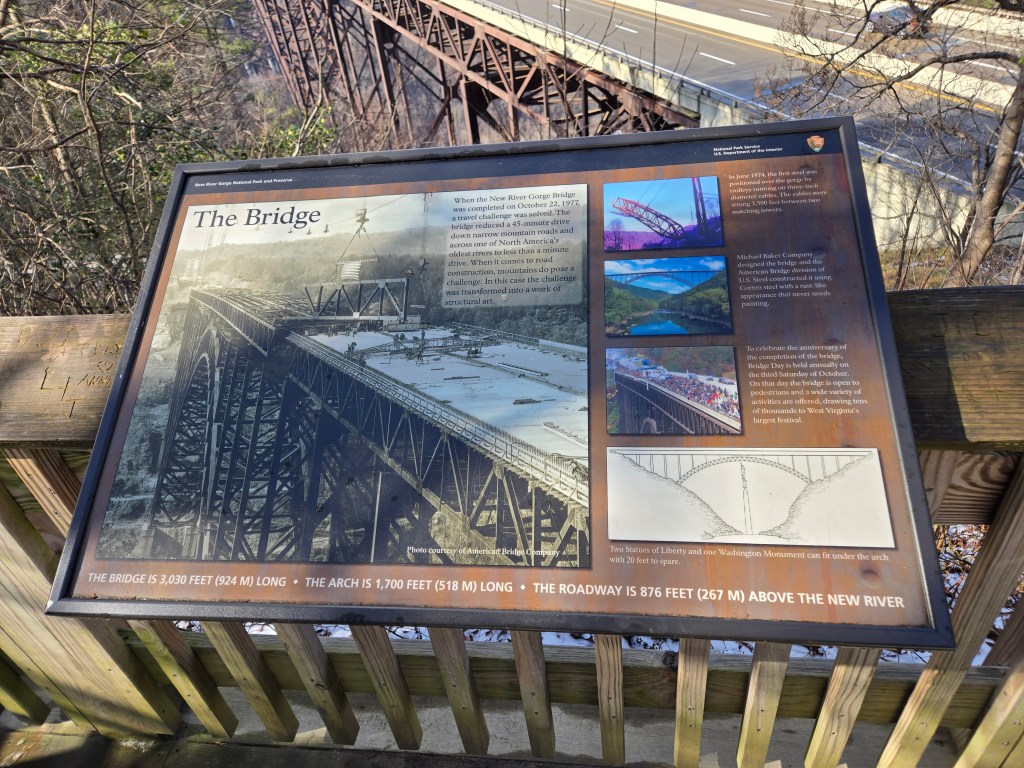
Construction began in 1974, and the bridge opened to traffic on October 22, 1977. When completed, it measured 3,030 feet long, with its roadway 876 feet above the New River. It was an extraordinary engineering achievement, especially considering the rugged terrain where it was built.
But I don’t have to imagine what it was like to see the bridge under construction. I have my own memories.
During my junior year of high school, in 1973–1974, I was taking driver’s education. Our teacher would take us out to practice driving, and one of the places we visited was Route 19, near where the bridge was being built.
We would drive down close enough to watch the work, but not too close. Sometimes we stopped for a few minutes to watch the men working on this enormous project.
I found it fascinating.
Even then, I understood what that bridge would mean for people traveling between Fayetteville and Oak Hill. The trip would be much shorter, without all those winding mountain curves.
And believe me, I appreciated that! I got carsick traveling over the mountain, so the thought of a quicker, straighter route was mighty appealing.
Today, we look at the New River Gorge Bridge as a familiar landmark. It stands high above the river, carrying thousands of vehicles through the gorge and giving visitors a spectacular view of the surrounding mountains.
But I remember when it was still a construction project. I remember stopping along Route 19 with my driver’s education class and watching the men at work.
I didn’t realize then how special it would be to look back years later and say that I had watched this remarkable bridge being built.
Sometimes we don’t realize we’re watching history until we look back on it.
And the bridge wasn’t just going to change the journey for people like me. It would become part of the lives of families throughout the region—including my own.
Looking back, I’ve learned something about history. When we’re living through it, we don’t always recognize how important a moment will become. We go about our everyday lives, watching things happen without realizing that someday we’ll look back on them as part of a much bigger story.
But when we have a personal memory attached to that history, it becomes something special. We aren’t just reading about what happened. We can remember being there, watching it unfold, and wondering what it would mean for the future.
That’s how I feel about watching the New River Gorge Bridge being built. At the time, I was simply a high school girl learning to drive. Today, I’m grateful that I have that memory to share.
Section 4: A Bridge and a Family Memory
Not everyone looked at the New River Gorge Bridge with the same excitement I felt watching it being built.
I remember my Grandma Johnson being afraid to cross the bridge for the first time. I believe that happened in early 1978, just a few months after the bridge opened and before her mother, Grandma Wilson, passed away that September.
I’ve often thought about how the events of the preceding decade might have influenced how people felt about bridges.
On December 15, 1967, the Silver Bridge connecting Point Pleasant, West Virginia, and Gallipolis, Ohio, collapsed during rush-hour traffic. Forty-six people lost their lives in the disaster. The investigation determined that a tiny fatigue crack in one of the suspension-chain links caused the failure.
When the New River Gorge Bridge opened in October 1977, the Silver Bridge tragedy was still a recent memory for many West Virginians.
I can’t say for certain that the Silver Bridge disaster was the reason Grandma Johnson was afraid. She never left us a written explanation of her feelings. But I can understand why someone who had lived through those years might have approached a towering new bridge with apprehension.
My reaction had been different. I had watched the New River Gorge Bridge being built and looked forward to the shorter trip between Fayetteville and Oak Hill. Grandma Johnson faced that same bridge with fear.
Two people. Two different experiences. One remarkable bridge.
And that’s another thing history teaches us: the same event can mean something entirely different to the people experiencing it.
The New River Gorge Bridge was an engineering achievement, a transportation improvement, and eventually the centerpiece of one of West Virginia’s best-known annual celebrations. But for the people who first crossed it, it was also something new—something they had to learn to trust.
Section 5: A Personal Connection to the Gorge
The New River Gorge is more than a beautiful view to those of us who live nearby. It’s a place where people work, spend time with family, and build connections to the landscape.
Tim has his own connection to the area. When he worked at Hawks Nest State Park, he would sometimes go with his Uncle Dave to the Canyon Rim Visitor Center to help maintain the grounds.
Their work included mowing the grass, trimming trees when needed, and cleaning up leaves and other debris. It was the kind of everyday work that helps keep a place welcoming for the people who visit.
Today, visitors arrive at Canyon Rim to see the New River Gorge Bridge and take in the view of the gorge below. They come for photographs, sightseeing, and a chance to experience one of West Virginia’s most recognized landmarks.
Most visitors see the finished grounds and the spectacular scenery. They may not think about the people who helped keep the property looking its best.
But those workers are part of the story, too.
Tim’s connection reminds us that the New River Gorge isn’t just a destination for tourists. It’s part of the working lives and personal histories of the people who call this area home.
And that brings us to the event that puts the bridge in the spotlight every October.
Bridge Day!
Bridge Day: A West Virginia Tradition
Every third Saturday in October, something special happens here in Fayette County. Thousands of people come from near and far to celebrate Bridge Day, West Virginia’s largest single-day festival. For one day each year, the New River Gorge Bridge becomes a place for visitors to walk across, enjoy the views, shop with vendors, and watch experienced BASE jumpers leap from the bridge into the gorge below.
It’s quite a sight to see! The bridge that carries everyday traffic across the gorge becomes the center of a celebration filled with excitement, activity, and plenty of mountain scenery.
And if watching people jump from a bridge nearly 876 feet above the river isn’t exciting enough for you, there’s plenty more to enjoy. Vendors offer food, crafts, and merchandise, while visitors get a chance to see the gorge from a perspective they don’t experience during an ordinary trip across Route 19.
The Celebration Begins on Friday
The fun often starts before Bridge Day itself.
On Friday evening, October 16, 2026, visitors can attend Taste of Bridge Day at Adventures on the Gorge. This annual gathering features food from local restaurants, food trucks, and caterers, along with local artwork and live music. It’s a wonderful way to sample some local flavor and get into the Bridge Day spirit before Saturday’s festivities begin.
Getting to the Bridge
Of course, an event this popular brings plenty of traffic! Route 19 closes to regular vehicle traffic during Bridge Day, so visitors need to plan ahead.
Official event shuttles operate from designated parking areas, including locations in Oak Hill, Fayetteville, and the surrounding area. If you’re planning to attend, it’s a good idea to check the official Bridge Day website before leaving home for the latest shuttle locations, parking instructions, and event rules.
For Bridge Day 2026, the celebration takes place Saturday, October 17, from 9 a.m. until 3 p.m. Whether you’re coming to watch the jumpers, walk across the bridge, shop with the vendors, or simply enjoy the view, it’s a day when our corner of West Virginia welcomes visitors from all over.
More Than a Festival
For people who visit from other places, Bridge Day might be a once-in-a-lifetime experience. For others, it’s an annual tradition. But for those of us who live here, the bridge is part of our everyday landscape, and Bridge Day gives us a chance to see it through the eyes of people discovering it for the first time.
I think that’s one of the things I love about living in this part of West Virginia. We sometimes get so accustomed to the places around us that we forget how special they are. Then someone comes from hundreds of miles away, looks out over the gorge, and reminds us just how remarkable our home really is.
The New River was here long before the bridge. The bridge changed how we traveled through the mountains. And Bridge Day turned that remarkable structure into the centerpiece of a tradition that brings people together year after year.
That’s quite a story for a bridge that once was just a construction project we stopped to watch along Route 19!
A River, a Bridge, and a Place to Call Home
The New River has been flowing through these mountains for a very long time. The gorge it carved, the communities that grew around it, and the bridge that now spans it all have stories worth remembering.
Some of those stories are written in history books. Others are preserved in photographs, old records, and the memories of people who lived through the changes.
And sometimes, those stories come together in unexpected ways.
I can look at the New River Gorge Bridge today and remember being a high school girl learning to drive, stopping along Route 19 to watch the construction. I can remember how much I looked forward to a shorter trip between Fayetteville and Oak Hill. And I can remember that my Grandma Johnson didn’t share my excitement about crossing that new bridge.
Those memories remind me that history isn’t just about dates and events. It’s also about the people who experienced them, the changes they witnessed, and the different ways those changes affected their lives.
Bridge Day gives us a reason to celebrate the bridge, but it also gives us an opportunity to appreciate the river and the gorge that make this place so remarkable.
So, whether you’re walking across the bridge this weekend, watching the jumpers, enjoying the vendors, or simply admiring the view from a favorite overlook, take a moment to look beyond the celebration.
Think about the river flowing far below. Think about the people who built the bridge and the generations who have traveled across it. And think about all the stories this landscape could tell if those mountains could talk.
Here in West Virginia, our mountains hold more than scenery. They hold our history, our memories, and a little piece of our hearts.
Happy Bridge Day, everyone! And if you’re visiting our beautiful corner of the Mountain State, welcome. We hope you’ll enjoy your time here and leave with a story of your own.
SOURCES & FURTHER READING
This article brings together local memories, personal experiences, and the history of the New River Gorge. The following resources offer more information about the river, the bridge, Bridge Day, and the Silver Bridge tragedy.
The New River and the National Park
- A River Runs Through It — National Park Service
Learn about the New River’s northward journey, its remarkable age, the gorge, and the area’s natural and cultural history. - New River Gorge Bridge — National Park Service
Explore the bridge’s construction, engineering, opening in 1977, and the difference it made to travel through the gorge. - New River Gorge National Park and Preserve — National Park Service
Find more information about the park, its history, recreation, and places to visit.
Bridge Day and Taste of Bridge Day
- Official Bridge Day Website
Learn about the festival, its history, and the activities that make Bridge Day a West Virginia tradition. - Bridge Day Information: Parking, Shuttles, and Festival Rules
Check the latest event information before making plans to attend. Parking, shuttle arrangements, and event rules can change. - Taste of Bridge Day
Find information about the Friday evening celebration featuring local food, music, and artwork.
Remembering the Silver Bridge
- Silver Bridge Collapse and the Creation of National Bridge Inspection Standards — Federal Highway Administration
Read about the December 15, 1967, Silver Bridge collapse, the loss of 46 lives, and how the tragedy helped lead to modern bridge inspection standards.


Leave a Reply