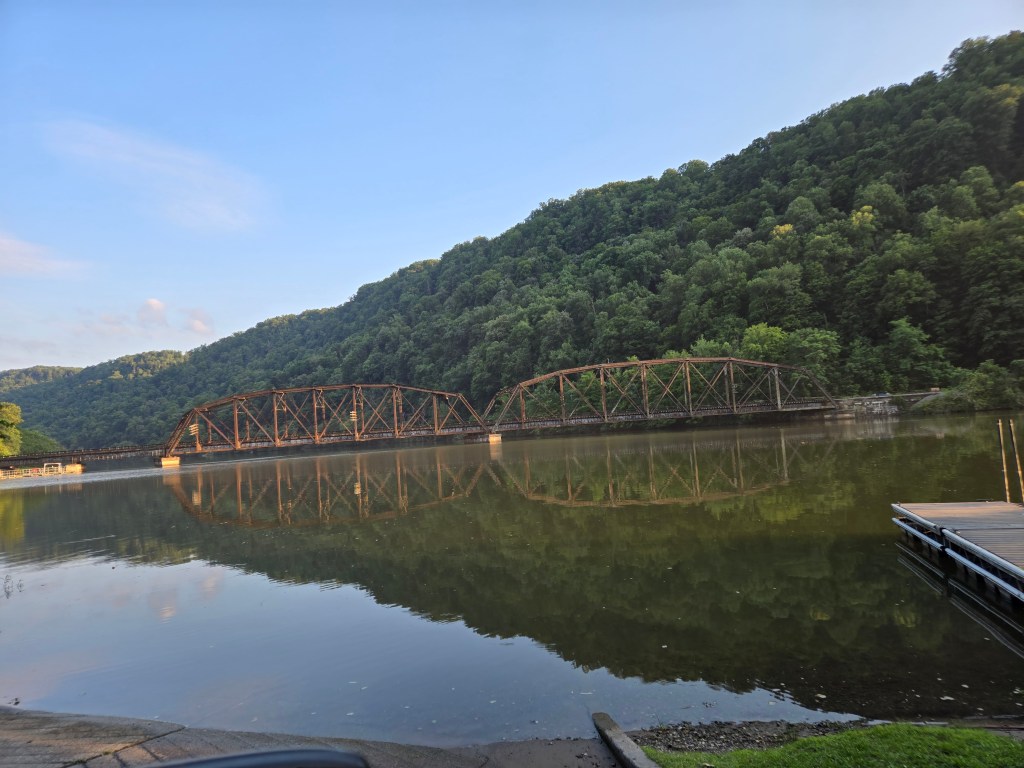
Before the Railroad arrived, Hawks Nest was already a place with a story
In our last look at Hawks Nest, we discovered that this rugged stretch of the New River was being used long before the C &O Railroad arrived. There were people living in the area, roads connecting communities, travelers making their way along the James River and Kanawha Turnpike, and Millers Ferry carrying people across the New River as the mouth of Mill Creek.
So how did the railroad become part of the story?
That’s the question we’re going to follow.
The C&O Railroad didn’t simply appear one day and create Hawks Nest. Its arrival in 1873 would bring tremendous changes to the area, but those changes came after decades of people finding ways to live, travel, work, and make their way through these mountains.
Before there was a railroad, there was a road.
And before there was a road, there was a reason to go somewhere.
For the people who lived around Hawks Nest, those connections mattered.
A Community Already Connected
Long before a locomotive whistle could be heard echoing through the New River Gorge, Hawks Nest was already connected to the world around it.
The James River and Kanawha Turnpike produced an important route through the region, carrying travelers and goods through the mountains. At Hawks Nest, the river itself became part of that transportation network.
Miller’s Ferry crossed the New River at the mouth of the Mill Creek, providing a way for people traveling between the communities on either side of the river.
And this wasn’t simply a ferry sitting by itself at the water’s edge.
Roads connected the ferry to the surround country. Thomas Hamilton was involved in that transportation network as well. In 1837, the county court appointed Hamilton to survey, locate, and mark a road from Fayetteville to the James River and Kanawha Turnpike.
By the time the railroad eventually came along, people already knew how to get to Hawks Nest.
They had roads.
They had the river crossing.
They had places to stop.
And they had reasons to come.
Thomas Hamilton and a Growing Settlement
By the 1830’s Hawks Nest was becoming more than a convenient place along the river.
Thomas B. Hamilton and his family moved to the Hawks Nest area from Summersville shortly after Fayette County was formed. Hamilton established a law practice here and became involved in matters involving land and transportation.
In 1837, the county court appointed Hamilton to survey, locate and mark a road connecting Fayetteville with James River and Kanawha Turnpike. Around this same period, Miller’s Ferry was established across the New River at the mouth of Mill Creek, with roads leading to the ferry through Hamilton lands.
Thomas Hamilton eventually developed a substantial estate at Hawks Nest. Historical records indicate that his property grew to as much as 526 acres, stretching from the area east of what is now the Hawks Nest overlook toward the New River.
But Hamilton’s connection to Hawks Nest wasn’t only about land.
His home became a place where travelers could stop along the turnpike. Thomas and his wife Elizabeth, operated an inn there, described in the records of the time as a “house of private entertainment.” The inn eventually became the first Hawks Nest post office.
Think about what that tells us.
Before there was a railroad station, there was already a place where travelers could stop, rest, exchange news, and continue on their way.
We don’t have the words of every traveler who stopped there, so we can’t know exactly what they thought about this little community tucked into the mountains.
But we can wonder.
What dit they see when they arrived?
Did they see Hawks Nest as a destination, or simply a stopping place along a much longer journey?
And what did the people who lived here think when they watched travelers from other places pass through their community?
We may never know all their answers.
But the records show us that Hawks Nest was already connected to the outside world long before the railroad arrived.
A Landscape Already in Use
The Civil War gives us another glimpse of Hawks Nest before the railroad arrived.
In 1861, the area around Millers’ Ferry became important enough to the Union military that troops established Camp Anderson near the ferry. Military activity in the area included roads, river crossings, pickets, drill grounds, and movement between the New River and the surrounding communities.
The West Virginia State Archives preserves photographs identified as “Log House on Miller’s Ferry,” “Picket on New River, Camp Anderson, ” and “Picket on Lover’s Leap/ Road to the Log House.
Those photographs are more that pictures of soldiers
They give us clues about the place itself.
There was a ferry.
There were roads.
There was a log house.
There were people moving through the landscape.
And there was a military encampment occupying a place that was already accessible enough to be used for those purposes.
We don’t know what every person living around Hawks Nest thought as soldiers arrived and occupied the area. We don’t have their conversations recorded for us.
But we can wonder.
What must it have been like to live along the river when your familiar roads and ferry suddenly became part of a military landscape?
And what did those same people think when the soldiers eventually left?
The Civil War would, pass, but Hawks Nest would not return to exactly the same world it had know before.
The region was changing.
And another change was coming.
The railroad.
After the War, Before the Railroad
When the Civil War ended, the mountains around Hawks Nest returned to a quieter kind of life–but the world around them was changing.
The roads and river crossings that had served travelers before the war were still important. Miller’s Ferry remained part of the local transportation network, and the communities along the New River continued to depend on roads, the river, and the turnpike to connect with the rest of the region. But by the years following the war, another possibility was beginning to take shape.
A railroad.
For someone living at Hawks Nest, the idea of a railroad through this rugged country must have seemed almost extraordinary. The mountains that had already made travel difficult were the same mountains railroad builders now had to overcome.
And that raised a question I keep coming back t”
Why Hawks Nest?
Why bring a railroad through this particular stretch of the New River Gorge?
The answer isn’t simply that someone looked at a map and decided to draw a line through the mountains. The railroad was part of a much larger effort to connect the interior of West Virginia with markets and transportation routes beyond the mountains.
And Hawks Nest had something railroads needed:
a route through the gorge and access to the resources of the surrounding mountains.
Coal would eventually become an enormous part of this story.
But here’s where we need to slow down.
It’s tempting to look at the later coal mines and railroad branches and assume that the coal industry was already established at Hawks Nest before the railroad arrived.
We don’t yet have enough evidence to say that
That’s one of those questions we’re still researching.
What we do know is that the railroad and coal development would eventually become closely connected – and that connections would transform Hawks Nest and the surround communities.
So, as the 1860s gave way to the 1870s, the people who already lived her were standing at the edge of a very different future.
They had known the river.
They had known the roads.
They had know the ferry.
They had watched soldiers come and go.
Now they were about to watch something entirely new make its way into the mountains,
The railroad was coming.
The Railroad Comes to the New River
The Chesapeake & Ohio Railroad was built in a single leap. Construction through West Virginia was underway from 1869 to 1873, with crews working from both the east and west ends of the line. The New River Gorge presented some of the most difficult construction on the route because of the steep mountains, narrow river valley, rock, and limited room for a railroad grade.
For the men building the railroad, this wasn’t simply a matter of laying track across an open field.
They had to blast through rock, build bridges, cut grades and tunnels, and somehow make a railroad fit into a landscape that had been shaped by the river and mountains for thousands of years. The National Park Service describes hundreds of men working through the gorge, including thousands of formerly enslaved African Americans and Irish immigrants. Much of the work was done with hand tools, explosives, horses and mules.
And Hawks Nest presented one particularly important challenge.
New River Had to be crossed.
By 1872, C&O engineers and workers had completed a large wooden truss bridge across the New Rvier at Hawks Nest. That bridge became part of the final connection between the eastern and western sections of the railraod.
Imagine what that must have looked like to someone who already knew this landscape.
For generations, the river had been something people crossed by ferry.
Now men were building a massive structure across it so that a train could cross the very same river.
That’s one of those moments where we can look at the documented facts and allow ourselves to wonder:
What did the people living nearby think when they say that bridge taking shape?
They had watched travelers arrive by road.
They had watched people cross the river by ferry.
They had watched soldiers occupy the area during the Civil War.
And now, something enormous was being built across their river.
The railroad was no longer an idea somewhere far away.
It was right there.
January 1873
By January 1873, the work was nearing its dramatic conclusion.
On January 29, 1873, the final rail was laid at Hawks Nest, and the last spike was driven at approximately 1 p.m. Contemporary reporting from the Wheeling Register described the event as the completion of the railroad connecting the Chesapeake with the Ohio and the eastern seaboard with the Ohio and Mississippi river system.
The C&O had finally connected Richmond, Virginis, with Huntington, West Virginia.
But there is an important little detail her that I think makes our story even more interesting.
The ceremonial completion wasn’t the same thing as everything suddenly being finished.
The railroad officially opened for commercial traffic in March 1873, and work continued on the line afterward as crews completed cuts and dealt with slides and other unfinished construction. Regular operations developed over the following months.
So when we picture that January day at Hawks Nest, we shouldn’t imagine that the mountains suddenly went quiet, the workers packed up, and the railroad was instantly running like the modern railroad we know today.
The railroad had arrived.
But the transformation of Hawks Nest was only beginning.
What did this mean for the people who were already living here:
More people.
New Jobs.
Travelers.
Goods.
Coal.
Businesses.
Noise.
Construction.
And a whole new way for people who had only heard about these mountains to actually come see them.
A New World Arrives
The arrival of the C&O Railroad changed more that the way people traveled through Hawks Nest.
It changed who could get there, what could be carried out, what could be brought in, and what kinds of work could suddenly become possible.
The railroad opened the New River Gorge to a much larger world. Coal began moving out of the gorge toward markets, while people began coming into the region for work, business, and opportunity. The National Park Service describes the railroad’s opening as a turning point that brought both freight and passenger travel into a gorge where roads were limited and river travel could be difficult.
And the change came quickly.
The coal industry that would eventually dominate the New Rvier region grew rapidly after the railroad arrived. The West Virginia Coal Heritage program notes that hundreds of independent mining operations sprang up in Fayette and Raleigh counties during the 1870’s, while the New River Coalfield was producing hundreds of thousands of tons of coal by th end of that decade.
Hawks Nest was right in the middle of that developing story.
Historical records show that the Gauley-Kanawha Coal Company was organized in 1872, just before the C&O was completed. Its narrow-gauge branch along Mille Creek was being developed as the railroad route became known, connecting the C&O near Hawks Nest with mining operations toward Ansted. The line was completed around the time the main railroad reached Hawks Nest.
That gives us something particularly interesting to think about.
The railroad and the coal industry weren’t two completely separate stories that happened one after another.
They were developing alongside one another.
And suddenly, the people already living around Hawks Nest weren’t the only people who had reason to be there.
Workers came.
Businesses followed opportunity.
Goods could travel farther.
And people who had never had an easy way to reach this remote section of the New River now had a railroad.
We know from later historical records that the region attracted workers from established mining areas as well as from the South, and the larger development of Fayette County brough African Americans, European immigrants, and others into the growing industrial workforce.
But here’s where I want to slow down and let ourselves wonder for a minute.
Imagine someone who had spent their entire life knowing Hawks Nest as a place of mountains, river, roads, ferry crossings and familiar neighbors.
Now there are strangers coming into the area.
There are men working on the railroad.
There are trains carrying freight.
There are supplies arriving that once had to make their way over mountain roads.
And there are people arriving who may have known Hawks Nest only from a map, a newspaper, a railroad timetable – or stories they had heard somewhere else.
What did the people who already lived here think about all of this?
Were they excited about the possibilities?
Did they see new jobs for their families?
Did they wonder whether their land would become more valuable?
Were some worried about what all this change world mean?
Did children gather near the tracks to watch the trains/
We don’t have the personal words of everyone who witnessed those changes.
So we won’t pretend that we know exactly what they thought.
But we do know the landscape was changing around them.
And within just a few years, the little community along the river would be tied to a railroad that connected Hawks Nest to places far beyond these mountains.
Hawks Nest was no longer simply a place people traveled through.
It was becoming part of something much larger.
When Hawks Nest Became a Railroad Community
The railroad had arrived, but the transformation of Hawks Nest was only beginning.
The C&O’s main line crossed the New Rvier at Hawks Nest, with the railroad initially running along the northside of the river between Fayette and Hawks Nest before crossing to the south side. Hawks Nest itself remained an important landmark, visible from the river, the ferry, and eventually the railroad depot.
And then something happened that would tie Hawks Nest and Ansted together for generations.
The railroad began climbing Mill Creek.
The coal interests developing around Ansted needed a way to get their coal to the C&O main line down at the river. A narrow-gauge railroad was constructed along Mill Creek, connecting the mining area with the C&O at Hawks Nest. Sources differ somewhat on the exact construction timeline, so we’re going to preserve that question in our deeper research, but the connection was established in the early 1870’s as the coal industry was developing.
That little branch would eventually become known as the Hawks Nest Subdivision.
But here’s something I find fascinating.
Today, when we walk along the Hawks Nest Rail Trail, we’re walking along what was once a working railroad route. West Virginia State Park notes that the trail follows Mill Creek and that remains of a coal mine that operated in the 1920’s can still be seen along the trail.
So when we look at Mill Creek today, we aren’t just looking at a pretty creek winding through the mountains.
We’re looking at a corridor that became an industrial connection between the mines above Ansted and the C&O main line at Hawks Nest.
And that changed the meaning of Hawks Nest.
Before the railroad, people came here by road, turnpike and ferry.
Now people could arrive by train.
Coal could move toward the main line.
Supplies could move in.
Workers could travel.
And the little community that had once been connected primarily by the mountain roads and the river was becoming connected to a railroad network that stretched far beyond West Virginia.
Imagine standing beside Mill Creek during those early years.
You would still see the same mountains.
The same river would still be flowing below.
People would still know the old roads and familiar landmarks.
But now there was something new in the landscape:
A railroad climbing the creek toward the mountains.
And somewhere along that route, the sounds of the old Hawks Nest community were being joined by the sounds of industry.
We don’t know exactly what every person thought about those changes. \But I wonder…
Did the people who lived here for generations realize they were watching the beginning of a completely different Hawks Nest?
The Beginning of a New Hawks Nest
The railroad brought Hawks Nest into a world that was much larger than the one connected by the old turnpike and ferry.
But the railroad did not simply bring people to Hawks Nest.
It created a way for the resources of the mountains to move out.
That mattered enormously in the years that followed.
The developing coal industry around Ansted and Mill Creek now had a transportation connection to the C&O main line. What had once been difficult to move through the mountains could now be carried by rail toward larger markets.
And with that opportunity came more development.
More workers were needed.
Businesses had new customers.
Communities grew.
The landscape around Mill Creek began to change.
The little roads and paths that had once carried travelers toward the river were joined by the railroad tracks carrying coal, supplies and people.
Hawks Nest was becoming something different.
But perhaps it is important to remember that the railroad did not erase the Hawks Nest that existed before it.
The ferry had been there.
The roads had been there.
The families had been there.
The river had been there.
The mountains had been there.
The railroad simply became the newest -and eventually one of the most powerful connections between this little corner of the New River and the Outside world.
And I keep thinking about those people who had watched it all happen.
A generation earlier, they had crossed the river by ferry.
Now a train could carry someone across that same river in minutes.
Someone who had spent their entire life traveling by horse or wagon could suddenly watch a locomotive thunder through the mountains.
Someone who had always thought of Hawks Nest as home might now see strangers arriving who had never heard the river at night, never traveled the old turnpike, and never crossed Miller’s Ferry.
What did they think?
We may never know.
But we can look at what happened next.
Because the arrival of the railroad was not the end of the Hawks Nest story.
It was the beginning of a new chapter.
And that’s where we’ll leave this part of the story.
In the next chapter of our Hawks Nest history, we’ll follow the railroad and the coal industry deeper into Mill Creek and Ansted. Where Mines, workers, businesses, rail lines and communities would reshape the landscape once again.
And maybe, as we follow those tracks, we’ll begin to see some of the places we’re familiar with today in a completely different way.
📖 Start at the Beginning: If you missed our first look at Hawks Nest, read Hawks Nest: More Than a Place on the Map
Sources & Further Reading
West Virginia Archives and History — historical material on the Hamilton family, Hawks Nest, Miller’s Ferry, and the Civil War period.
West Virginia History OnView — photographs from the Camp Anderson/Miller’s Ferry area, including the 1862 images by J. N. Roesler.
West Virginia State Historic Preservation Office — Fayette County architectural and historical survey material concerning the Hawks Nest railroad, coal development, and Mill Creek
. National Park Service — history of the Chesapeake & Ohio Railroad and railroad construction through the New River Gorge.
West Virginia Coal Heritage — historical information on the development of the New River coalfields after the railroad arrived.
West Virginia State Parks — Hawks Nest Rail Trail and the historic mining remains along Mill Creek.


Leave a comment