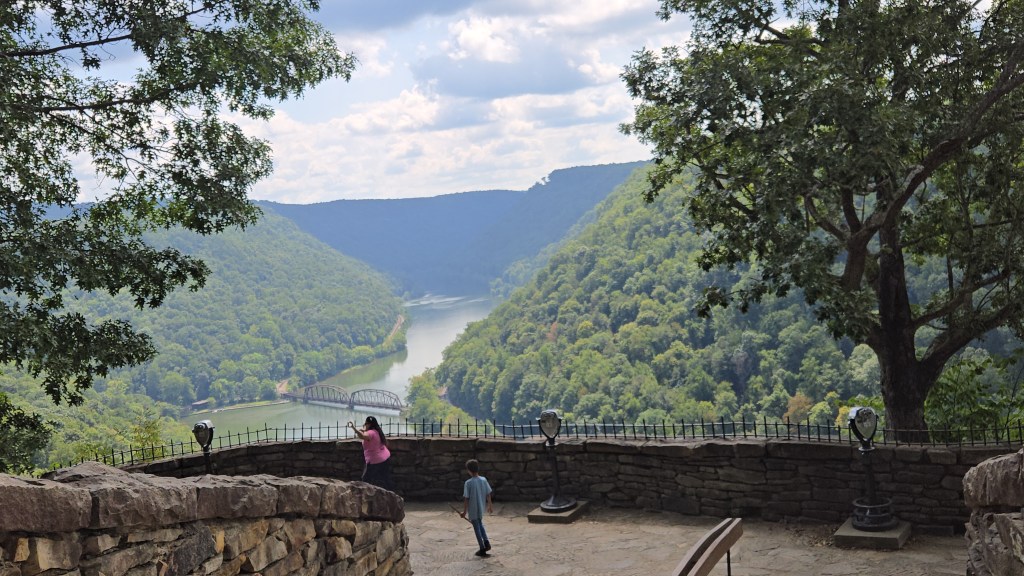
Today, Hawks Nest State Park is a familiar part of the New River Gorge landscape, but the park itself is only one chapter in a much older story. Long before there was a state park, there was Hawks Nest—the dramatic mountain landmark that drew travelers, inspired writers, and became part of the story of the New River.
So how did this remarkable place go from a celebrated mountain landmark to the Hawks Nest State Park we know today? To answer that question, we have to look at the people, roads, buildings, and changing ideas about this special place over the years.
Before There Was A State Park
Hawks Nest was already a celebrated landmark long before the state park was created. The cliffs were originally known as Marshall’s Pillars, named in connection with Chief Justice John Marshal’s 1812 expedition through the region. Over time, the name Hawks Nest became associated with the cliffs and the osprey that nested there.
By the late 1800’s the landscape was changing. The Chesapeake and Ohio Railway reached the area, and the railroad became part of the growing network connecting communities through the New River Gorge. Hawks Nest was no longer simply a dramatic landmark along an older travel route; it was becoming part of a changing industrial and transportation landscape.
Hawks Nest Becomes a State Park
The 1930’s brought enormous changes to Hawks Nest and to West Virginia’s approach to preserving its scenic places. In 1935, the state purchased the lands that became Hawks Nest State Park. The timing was significant. West Virginia was building its state park system during the Great Depression, with the Civilian Conservation Corps (CCC) playing an important role in developing parks across the state.
At Hawks Nest, the CCC’s work helped transform the landscape into a place designed for public recreation. young men working through the program-built facilities that included a picnic shelter, shop, museum, and restrooms. They constructed the Hawks Nest Overlook from local sandstone in the mid-1930’s. Some of that early CCC work is still part of the park visitors see today.
That is one of the things that makes Hawks Nest State Park so interesting. When we stand at the overlook or use some of the park’s older facilities today, we aren’t simply looking at a modern recreation area. We are seeing pieces of a 1930s effort to preserve and develop one of West Virginia’s remarkable landscapes.
A Park That Continued to Change
The story of Hawks Nest State Park did not end with the CCC. The park continued to change as West Virginia developed new ideas about recreation and tourism. The original 1930’s work remained an important part of the historic area, while new facilities were added to serve visitors.
In 1963, the West Virginia Department of Natural Resources took control of the property. A new lodge was built in 1967, giving Hawks Nest a very different kind of visitor facility while the older CCC-era structures continued to tell an earlier part of the park’s story. The aerial tram followed in 1970, adding another way for visitors to experience the gorge.
That combination of old and new is one of the things that makes Hawks Nest unusual. A visitor can stand among structures dating to the park’s Depression-era development and, only a short distance away, see facilities from a completely different generation of park development.
Looking at Hawks Nest Through Today’s Eyes
One of the fascinating things about Hawks Nest State Park is that pieces of its earlier history are still visible if you know what you are looking for. The park has changed over the decades, but the landscape also holds reminders of people who helped shape it.
The Hawks Nest Overlook is one of those reminders. According to West Virginia State Parks, the overlook was constructed in the mid-1930’s by the Civilian Conservations Corps using local sandstone. The CCC’s work can also still be seen in the other parts of the park, including the picnic shelter, shop and restrooms that remain in use today.
Standing there today, however, comes with an important limitation. We are seeing Hawks Nest with modern eyes. Roads, buildings, vegetation, trails and the surrounding landscape have changed since the 1930’s. What we see can give us clues about the past, but it cannot show us exactly what a visitor would have seen generations ago.
That is where historical photographs, maps, documents, and personal memories become important. They allow us to compare the Hawks Nest we can see today with the Hawks Nest that earlier generations knew.
Seeing Hawks Nest Through Our Own Eyes
When Tim and I visited Hawks Nest while we were researching the dam and tunnel we decided to slow down and really look at the park itself. We parked near the restrooms and gift shop and began taking in the area around the historic shelter. From the parking area, we could see the Midland Trail Shelter in the distance, with the restrooms building on one side and the gift shop on the other. A trail let up behind the shelter, giving us another reminder that Hawks Nest is more than a single overlook.
We followed the paved walkway toward the overlook and found several places that made us stop and look. There was a wonderful spot for photographing Hawks Nest Dam, and we noticed an accessible viewing area with a mounted viewfinder so visitors using wheelchairs could enjoy the scenery as well. West Virginia State Parks describes the overlook trail as a short, paved route that has been improved to ADA standards.
From there, we continued down the stone steps toward the overlook’s stone patio. The stonework, the surrounding wall and the view made it easy to understand why this location has attracted visitors for generations. From the overlook, we could see the New River canyon, Hawks Nest Lake behind the dam, and far below, the riverfront area of the park where the aerial tram descends toward the gorge.
Standing there, we found ourselves doing what we often do when we’re researching Hawks Nest: Looking at what is here today and wondering what earlier visitors saw from this place.
What Remains of the Early Park
When we look at Hawks Nest State Park today, it can be easy to see it simply as a place to visit. But scattered throughout the park are pieces of its earlier story. The stonework, older buildings, shelter, overlook and other features remind us that generations of people have used and cared for this place.
Some of those features date back to the park’s development during the 1930’s, while others belong to later periods of the park’s history. Together, they create a kind of timeline that can still be explored by visitors today.
That is part of what makes walking through Hawks Nest so interesting to us. Instead of looking at each building or stone wall as just part of the scenery, we can ask a different question: What story does this piece of Hawks Nest have to tell?
The Story Is Still Being Written
Hawks Nest State Park is not a place whose history ended when the park was created. Every generation has added another layer to the story. The roads changed, buildings were added, older structures were repaired or repurposed, and new ways of experiencing the gorge became part of the park.
Even today, there are questions we can ask about the places we see. Why was a particular building placed where it was? What did this area look like before the trees grew back? How did visitors move through the park when the CCC was doing its work.? What did earlier generations see from the overlook that we can no longer see today?
We may not always find an answer. But that doesn’t mean the question isn’t worth asking?
Sometimes the best part of exploring a place like Hawks Nest is realizing that there is still more to discover.
Come See Hawks Nest for Yourself
One of the best ways to understand Hawk Nest is to see it for yourself. Walk the paths look closely at the stonework, visit the overlook and notice the details that might be easy to pass by.
When you know a little of the history, the park begins to look different. A stone wall is no longer just a stone wall. An old building becomes a part of a story. A view becomes a connection to the generations who stood in that same place before us.
And if you happen to notice something we haven’t discovered yet, we’d love to hear about it.
Because the story of Hawks Nest isn’t finished.
Sources & Further Reading
This story was research using West Virginia State Parks, the West Virginia Encyclopedia, National Park Service information and historical sources relating to Hawks Nest and the development of the surround area.
Some questions about Hawks Nest remain unanswered, and those questions are part of what makes researching this place so interesting. As new records, photographs, maps, or memories come to light, this story can continue to grow.
West Virginia State Parks –Hawks Nest State Park
ihttps://wvstateparks.com/parks/hawks-nest-state-park/
West Virginia Encyclopedia — Hawks Nest State Park


Leave a comment